
Preventive Health Technology: Catching Problems Before They Start
- Preventive health technology covers screening tools, remote monitoring, wearables and algorithms that flag risk before symptoms appear.
- Prevention is organized into primary, secondary, tertiary and quaternary levels, and digital tools now support all four.
- Chronic disease drives most premature death and most spending, so it is where earlier detection pays off first.
- Daily behavior accounts for a large share of modifiable risk, with physical inactivity, tobacco use, poor diet and short sleep leading the list.
- Access to preventive care services differs enormously between and within countries, which limits what technology alone can fix.
- Aegis Capital invests in early-stage HealthTech & Longevity companies, with diagnostics and early detection among its focus areas.
What preventive health solutions cover
Preventive health solutions are tools and procedures used to reduce the probability of disease or to catch it at a stage where treatment still works. The category spans the ordinary and the technical: an annual check-up and a vaccination sit alongside continuous glucose monitoring, algorithmic risk scoring and imaging analysis.
Two features separate this work from clinical medicine as usually practiced. Prevention addresses people who feel well, so its value shows up as an event that never happens, and it operates on populations as much as on individuals. Both features make prevention easy to underfund and hard to measure, and both are why continuous data collection has changed the field so quickly. Some of the activities involved are clinical, for example a screening colonoscopy, while others sit entirely outside a clinic.
Primary, secondary and tertiary prevention in health care
Medicine divides prevention into levels, and each one calls for different tools. Primary prevention removes or reduces risk factors before disease develops, through vaccination, physical activity, diet and smoking cessation. Secondary prevention finds disease early in people without symptoms, which is what screening programs do. Tertiary prevention limits damage and disability once a condition is established, through rehabilitation and structured disease management.
A fourth level receives less attention and matters in a data-rich system. Quaternary prevention means protecting patients from unnecessary medical intervention, including tests that produce false positives and treatments whose harm exceeds their benefit. As monitoring expands, this would be the constraint that keeps prevention useful instead of merely busy.
Preventive health services and what a primary care provider checks
A primary care provider works from risk, not from symptoms. Age, family history, blood pressure, lipids, glucose, body weight, tobacco use and alcohol intake determine which preventive services someone should receive and how often. Family health history changes screening frequency more than most patients expect, since an early cancer or cardiac event in a first-degree relative usually moves screening forward by years.
In the United States, the Preventive Services Task Force publishes graded recommendations that define which preventive health services have evidence behind them. Its reviews are a useful filter in general, because they separate interventions that reduce mortality from those that merely detect more abnormalities. The key findings of each review state not only whether a test works but also for which age group it is effective.
Coverage of preventive care services in the United States
The Affordable Care Act, passed in 2010, required most insurance plans to cover recommended preventive services without cost sharing, which removed the copay as a reason to skip a screening. Coverage did not solve affordability. Gallup reporting with West Health has found that around 11% of US adults cannot afford needed care, and roughly one in three say they have cut back on health spending, a pattern visible in surveys since 2011.
Premiums explain part of the pressure. KFF put the average annual premium for employer family coverage at USD 26,993 in 2025, a cost split between employer and household that shapes what care people use. Financial barriers push prevention down the priority list, and the savings show up later as an emergency.
Access to preventive health services around the world
Availability, not evidence, is the binding constraint in most of the world. WHO data on life expectancy shows Japan among the highest performers and Malawi far below it, though the gap is closer to two decades than the 36 years sometimes quoted from older datasets, since child mortality in low-income countries fell sharply after 2000.
Workforce density explains much of the difference. WHO reports physician density per 10,000 people, and Nigeria sits at roughly four per 10,000, a figure often misquoted as four per 100,000. Under those conditions, prevention delivered by community health workers and by remote tools reaches more people than any clinic-based program could.
Screening for heart disease and cervical cancer
Two programs show what secondary prevention achieves when it is organized well. Cardiovascular screening looks for the precursors, since heart disease develops over decades through blood pressure, lipids and glucose that can be measured cheaply and treated with generic drugs. Nothing in preventive medicine has a better evidence base.
Cervical cancer screening works differently. It finds precancerous change, not early cancer. Cytology and HPV testing detect lesions that can be removed before they progress, and WHO has set an elimination target for cervical cancer built on vaccination, screening and treatment coverage. The programs share a structure worth naming:
- A long asymptomatic phase during which detection is possible.
- A test cheap and safe enough to apply to a whole population.
- An intervention that changes outcomes when applied early.
Conditions that lack any one of the three make poor screening candidates, whatever technology becomes available.
The burden of chronic disease and the cost of chronic illness
Chronic diseases account for most premature death in high-income countries. The Australian Institute of Health and Welfare reported that 46.6% of Australians had at least one chronic condition in 2021 and 18.6% had two or more, and comparable proportions appear across the OECD. Multimorbidity, not any single diagnosis, is what makes late-stage care expensive.
The cost side is well documented. An IHME analysis of US personal health spending found around USD 101 billion spent on diabetes in 2010, more than on any other condition, and most of that money treats complications that earlier intervention could have delayed. Obesity operates as a major risk factor across this whole group, poor nutrition is linked to several of the same diseases, and regular exercise reduces the risk of type 2 diabetes in trials that predate any digital tool.
Physical activity, diet, health and daily habits
Behavior sits upstream of most chronic disease. WHO physical activity guidelines, updated in 2020, recommend 150 to 300 minutes of moderate activity per week for adults, and physical inactivity is listed among the leading global risk factors for mortality. Tobacco smoking remains the single largest preventable cause of death, so smoking cessation delivers more benefit than any screening program.
Three other habits carry evidence strong enough to mention:
- Adequate sleep, which supports immune function and cardiovascular health.
- A diet built around vegetables, fruit and whole foods, which healthy diets research consistently links to lower disease incidence.
- Limited alcohol intake, since consumption correlates with several cancers and with liver and cardiovascular disease.
Oral hygiene belongs in the same conversation, given the documented association between periodontal disease and cardiovascular risk. Together these habits shape health and well being far more than any single medical appointment, and they include nothing that requires a device. These measures prevent illnesses in aggregate across a population, even though no individual can attribute a specific avoided disease to them.
Mental health in prevention
Prevention has a psychological component that clinical programs often treat as separate. Stress management affects blood pressure, glucose handling and sleep, and it changes whether people keep up the behaviors that protect them. A 2021 WHO and ILO analysis by Pega et al. attributed roughly 745,000 deaths in 2016 to long working hours through stroke and ischemic heart disease, which places working conditions inside the prevention agenda.
Untreated mental health problems also reduce engagement with preventive care and worsen quality of life alongside any physical diagnosis. Programs that ignore this side tend to show poor adherence and blame the patient.
Vaccination and prevention for children and adults
Immunization remains the clearest case of prevention with a measurable return. WHO estimates that vaccines prevent between 3.5 and 5 million deaths every year, and immunization contributed to the long rise in life expectancy across the last century.
Measles illustrates what happens when coverage slips. WHO recorded roughly 140,000 measles deaths in 2018 and about 207,500 in 2019, so the widely circulated claim that measles vaccination saved 140,000 children in 2019 inverts a death toll into a benefit. Child mortality overall tells a more encouraging story: around 7.6 million children died before their fifth birthday in 2010, and UN estimates put the figure below five million by the early 2020s.
Technology that finds disease before symptoms
Digital tools operate at the three points where prevention needs data it never used to have. Wearables and home devices generate continuous vital signs; algorithms score that data against population models to flag deviation; imaging and biomarker analysis detect structural change earlier than an examination does.
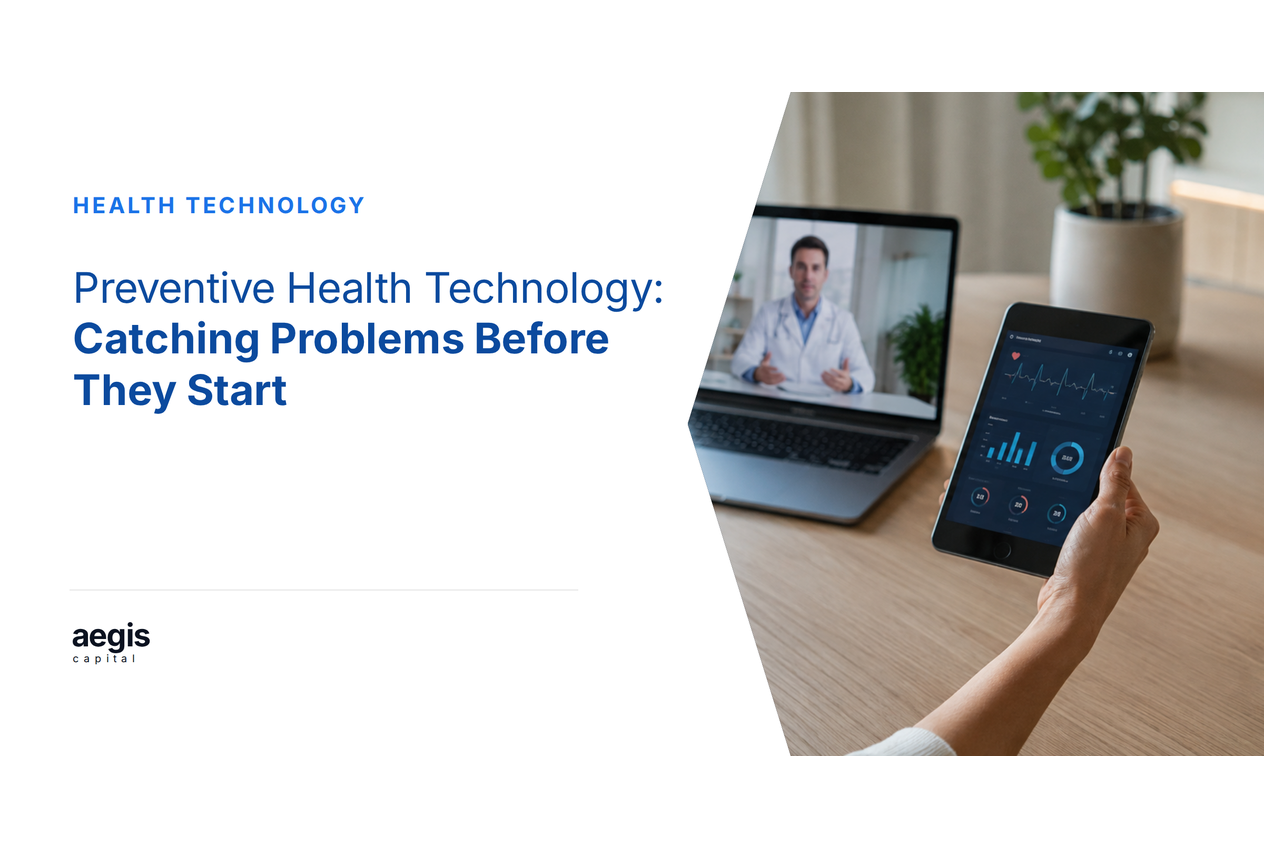
Remote patient monitoring has the strongest operational case. Certified telemedicine wearables track vital signs for older adults and people with chronic conditions, trigger alerts for caregivers, and integrate with health services at institutional scale, which lets someone stay at home who would otherwise need supervised care. AI-supported ECG systems extend the same logic to cardiology, and algorithmic analysis of MRI has moved orthopedic assessment in the same direction.
Example: Inoko Vision, a portfolio company of Aegis Capital, is developing a non-invasive optical device that reads eye movement as an objective biomarker of neurological state. The examination takes minutes, uses light at a wavelength invisible to the person being tested, and targets neurodegenerative change at the stage where protective strategies still have something to protect.
Long term savings from earlier detection
The financial argument for prevention rests on the difference between managing a risk factor and treating an event. Blood pressure control costs a few dollars a month; a stroke costs a hospitalization plus years of rehabilitation and lost work. Health systems that shift the mix toward earlier detection reduce readmissions and emergency utilization, and the effect compounds because most chronic conditions worsen predictably when untreated.
Two caveats keep this honest. Savings appear over years, on a timescale longer than most budget cycles, and screening a whole population costs money upfront regardless of how many events it later prevents. National programs that survive are the ones designed with both facts in view.
What prevention may be able to deliver, and what it cannot
Prevention shifts probability. It does not guarantee outcomes for any individual, and a technology that reports risk without a matching clinical action creates anxiety instead of health. The development of preventive tools has run ahead of the systems meant to act on their output, which is the gap worth closing next.
Evidence should decide what gets deployed. A screening test that finds more abnormalities without reducing mortality has failed, however impressive its detection rate, and this is where quaternary prevention and health economics do more good than another sensor.
Frequently asked questions
What is the difference between preventive and diagnostic care?
Preventive care assesses risk in people without symptoms, while diagnostic care investigates a complaint that has already appeared. The same test can serve either purpose depending on why it was ordered, which also determines how insurance treats it.
Which preventive health services are worth having annually?
That depends on age, sex and risk profile, not on a fixed list. Blood pressure, weight, lipids and glucose are checked routinely for most adults, while cancer screening intervals follow national programs and family history.
Can wearables replace medical screening?
No. Consumer devices detect trends and can prompt a visit, but their accuracy for diagnosis is limited, and any alert needs confirmation with clinical measurement.
Does prevention actually reduce health care costs?
For specific conditions, yes: vaccination, blood pressure control and tobacco cessation show clear returns. Across the whole system the picture is mixed, because keeping people alive longer creates additional care needs later.
How does family history change screening?
A relevant condition in a close relative typically moves the start of screening earlier and shortens the interval between tests. Anyone able to check for that information in their family should bring it to a primary care visit.
Tip: take control of one measurable number at a time. Blood pressure, weekly activity minutes or sleep duration each respond to intervention, and tracking one properly beats tracking six loosely.
