
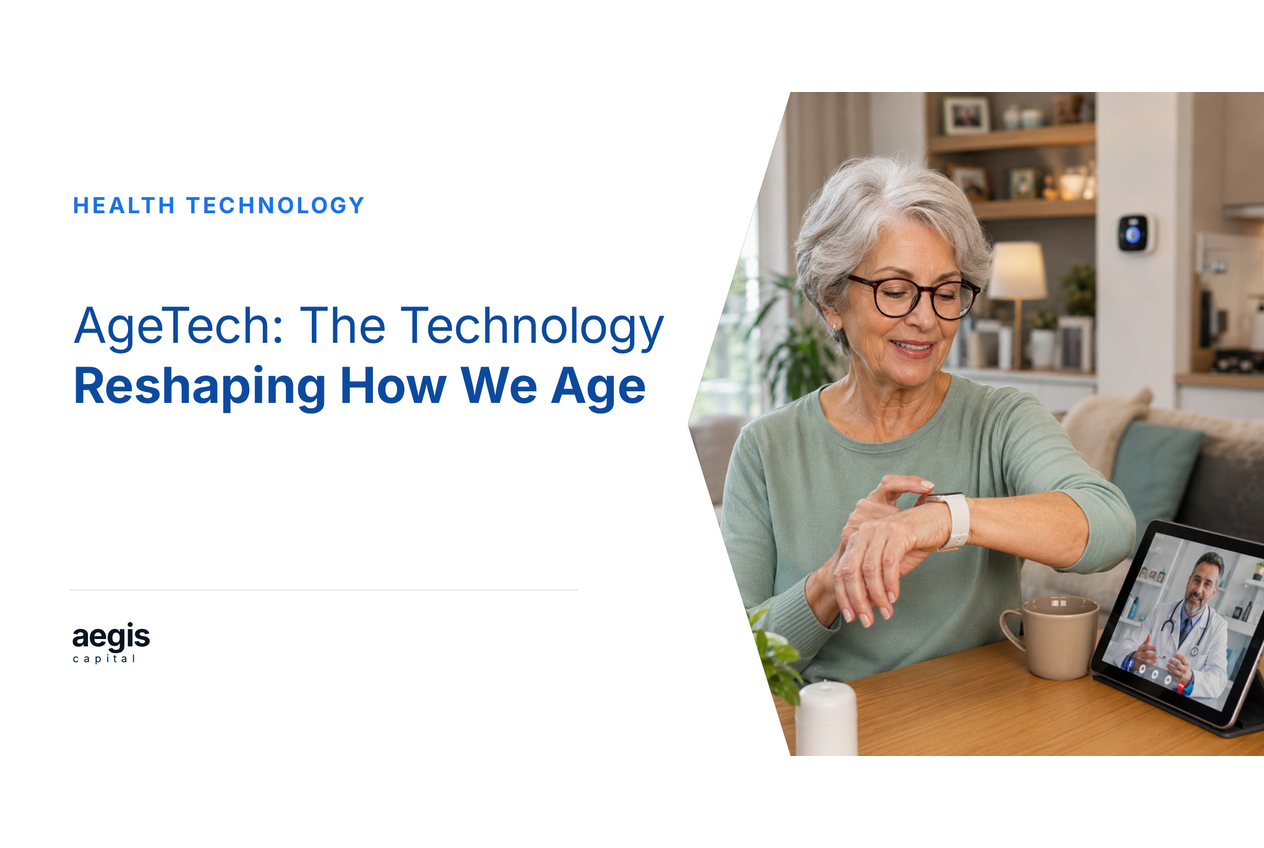
AgeTech: The Technology Reshaping How We Age
- AgeTech covers hardware, software and digital services designed for older adults and the people who care for them.
- The strongest evidence sits in remote monitoring, fall detection, medication support and telehealth access.
- Family caregivers are a second user group, and tools that reduce their load often sell better than tools aimed only at the patient.
- The longevity economy is large and frequently misquoted, so the numbers deserve checking before they enter a business plan.
- Reimbursement and integration with health systems decide adoption more than product quality does.
- Aegis Capital is a HealthTech & Longevity VC investing at pre-seed and seed stage in Central and Eastern Europe, and several of our investment areas run straight through AgeTech.
What AgeTech is, and what it does for older adults
AgeTech refers to hardware, software and digital services built to support the health, independence and quality of life of older adults. The definition is functional, not technical: a sensor, a tablet interface and a machine learning model all belong to the category if the problem they solve is one that comes with age.
Four groups of technology solutions account for most of what reaches the market. Smart home and internet of things sensors handle fall detection and environment monitoring. Digital health and wearables cover remote patient monitoring and telehealth. Communication and companion tools address isolation. Medication systems, including automated pill dispensers, keep a regimen on track. What connects them is a focus on real problems in the home, not on features that look impressive in a demonstration. The AgeTech ecosystem has grown around those four groups over the past two decades, and the innovators moving into it now are building on infrastructure that did not exist when the first telecare pendants appeared.
Making everyday aging easier at home
The design constraint in this field is unusual. A product has to work for someone who may have reduced vision, tremor, hearing loss or early cognitive decline, and who did not grow up with the interface conventions the rest of the market assumes. Voice control, large targets, simplified menus and defaults that do not need configuring do more for adoption than any additional capability. Products that ignore these challenges get bought once and abandoned within a month.
Continuous passive tracking is the other half of making aging easier. A device that a person does not have to operate, charge daily or remember to wear will collect data that a device requiring active use will not, and catching a change early is what prevents an emergency room visit later.
Devices and services that help people age well
Technology helps people age well when it removes a specific failure point. Three categories have the clearest case in current practice:
- Certified telecare wearables, which read vital signs continuously, raise an alert when something goes wrong and connect to care providers on the other end.
- Remote monitoring for chronic illness, which lets a clinician manage a condition without requiring the patient to travel.
- Telehealth platforms, which create a virtual connection between an older person at home and a clinician, and which matter most where local providers are scarce.
Safety is the thread running through all three, and a fulfilling aging experience depends on it more than on any single feature: a person who trusts that help will arrive behaves differently from one who does not.
Did you know: the technology spending of the 50-plus population in the United States is forecast to grow from USD 140 billion in 2018 to USD 645 billion in 2050, according to AARP's Longevity Economy Outlook. The size of the shift is one reason so many emerging technology companies have moved into this space in the past five years.
Care coordination and the caregiver's view
A product used by an older adult is very often bought, installed and monitored by an adult child. That makes caregivers a second user group with their own requirements: they need to know what happened without watching a live feed, and they need to hand information to a clinician in a form that a clinician will read.
Care coordination tools, including AI-supported ones, work on exactly this problem, and real-time data sharing reduces the load on families more directly than most patient-facing features do. Tools built for both sides of the relationship tend to keep users, because two people have a reason to care whether the device stays switched on.
The longevity economy and where the numbers actually come from
The commercial case for AgeTech rests on demographics, and the figures used to describe it are frequently repeated without their original meaning. One number circulates as an "8.3 trillion dollar market opportunity" in aging. Its source is AARP's Longevity Economy Outlook, where USD 8.3 trillion described the total economic activity of Americans aged 50 and over in 2018, roughly 40% of US GDP. That is the economic weight of a population, not a market anyone can sell into, and AARP's 2026 update puts the same measure at USD 12.5 trillion for 2024.
Globally the same series estimated that the 50-plus population contributed USD 45 trillion to world GDP in 2020. Both figures tell founders something useful about purchasing power and none of it substitutes for a bottom-up estimate of the people who would actually buy a given product.
Healthcare systems face the pressure from the other direction. Staffing does not scale with an aging population, long term care is expensive and hard to fund, and the gap between demand and workforce is what turns a convenience product into a necessary one. Affordable technology solutions that extend a small workforce across more people are the ones that public payers eventually notice.
What the Stanford Center on Longevity calls a new map of life
Longer lives change more than health care. The Stanford Center on Longevity built its New Map of Life initiative around the argument that century-long lives require rethinking work, education, housing and finance, not only medicine, and that treating age sixty-five as a single boundary no longer describes anything real.
For founders the practical consequence is that the market is not one segment. A newly retired sixty-year-old managing cognitive health and a ninety-year-old in senior living have almost nothing in common as users. Products designed for an average older adult usually fit neither, and the more useful question is which decade of later life a product serves.
Where AgeTech capital goes
Investment in this sector follows two separate logics. Consumer products chase the purchasing power described above. Clinical products chase reimbursement, and they take longer, cost more and last longer once they arrive. Forward thinking investors in this field usually have a view on which of the two a company is building, because the financing plans are not interchangeable.
Aegis Capital chooses to invest early, at pre-seed and seed stage, across Central and Eastern Europe. The fund provides an initial ticket of up to PLN 3 million and total funding of up to PLN 8 million per company across follow-on rounds, from a fund with a capitalization of PLN 80 million and 22 private investors. AgeTech is not a separate category in our thesis; it runs through diagnostics, AI and digital health, digital therapy and human improvement, which are four of the five areas we invest in.
How capital and partners accelerate technology out of the prototype stage
Money alone does not accelerate technology in a regulated market. What shortens the path is access to the people who can test a product in the setting where it will be used, and to the experienced investment professionals who have taken a certified device through approval before.
Example: Inoko Vision, a portfolio company of the fund, is developing an optical device that reads eye movement as an objective biomarker of neurological state, aimed at detecting neurodegenerative change before symptoms appear. Early detection of cognitive decline is one of the highest-value problems in aging, and it is also one where a research spin-off needs clinical partners long before it needs a sales team.
Tip: before raising, check whether a fund has taken a medical device through certification. The difference between a fund that has and one that has not shows up in the first year, not in the term sheet.
The AgeTech collaborative model: testbeds, pilots and networks
Nothing in this sector reaches scale through a single company. Care delivery involves clinicians, local providers, insurers, senior living operators and municipalities, and a product that ignores any of them stalls at the pilot stage. Industry leaders in aging innovation have converged on collaborative structures for that reason: shared testbeds, joint pilots and networks that connect leading startups with the organizations that would deploy them.
Creative testbeds matter more here than in most sectors, because a device that performs in a laboratory may fail in a flat with thick walls, an unreliable connection and a user who turns the router off at night. Ground breaking AgeTech innovations tend to come from teams who spent time in that flat.
Advisory board, venture partners and other forms of support
Founders often ask whether a fund brings an advisory board or something looser. At Aegis Capital the equivalent is a group of venture partners and a highly collaborative team that includes a physician and medtech founder with a digital health exit behind him, alongside partners with operational experience in building and scaling companies. Seasoned entrepreneurs in the network open doors that a fund cannot open on its own, and like minded entrepreneurs in the portfolio tend to solve each other's problems faster than any investor can.
Access to that community is the part founders underestimate at the seed stage and value most in the second year.
What we look for in AgeTech startups
Our filter is the same across every area we invest in. A defined problem, evidence that the product changes an outcome, a route through regulation where one applies, and a plan for getting into a workflow that already exists. Enlightened enterprises in this field win by fitting into care as it is delivered today, not by asking a health system to reorganize around them.
Three things carry weight in a first conversation with AgeTech founders:
- Who the buyer is, since the person using the product and the person paying are rarely the same.
- What happens after the alert, because detection without a defined response changes nothing.
- Whether the team has spent time with the users, given how unforgiving this group is about interfaces built on assumptions.
The next wave of companies in this space will be judged on powerful wellbeing outcomes, not on engagement metrics. Products that improve people's lives at home, keeping older adults safe and connected to their families, produce both a social result and strong financial returns, and that alignment is unusual enough in venture capital to be worth naming as part of the global mission this sector has taken on.
Frequently asked questions about AgeTech
What counts as an AgeTech company?
Any company whose product is built for the health, independence or daily life of older adults. Some AgeTech companies are medical device businesses, others are consumer or service businesses, and the regulatory path differs sharply between them.
Does AgeTech replace care from people?
No. It extends what a small workforce can cover and gives caregivers better information, and the most useful tools are the ones that make a human visit more effective, not simply less frequent.
Is AgeTech only for people living alone?
Living alone is the clearest use case, and the same tools support people in senior living and in family households, where they mostly reduce the coordination burden on relatives.
What is the biggest barrier to growth in this sector?
Payment. A product can improve independence and still fail commercially if no payer has a route to fund it, so understanding who pays is the first question a founder should answer.
How do investors evaluate AgeTech innovation?
By the same criteria applied to any health technology: evidence, regulatory route, integration and unit economics. The demographic argument explains the size of the future opportunity and settles nothing about whether a particular company will reach it.
